
Retail Value Versus A Sports Card Cash Offer
A direct collection offer differs from projected retail sales because the buyer takes on fees, labor, storage, time, condition risk, and unsold inventory.

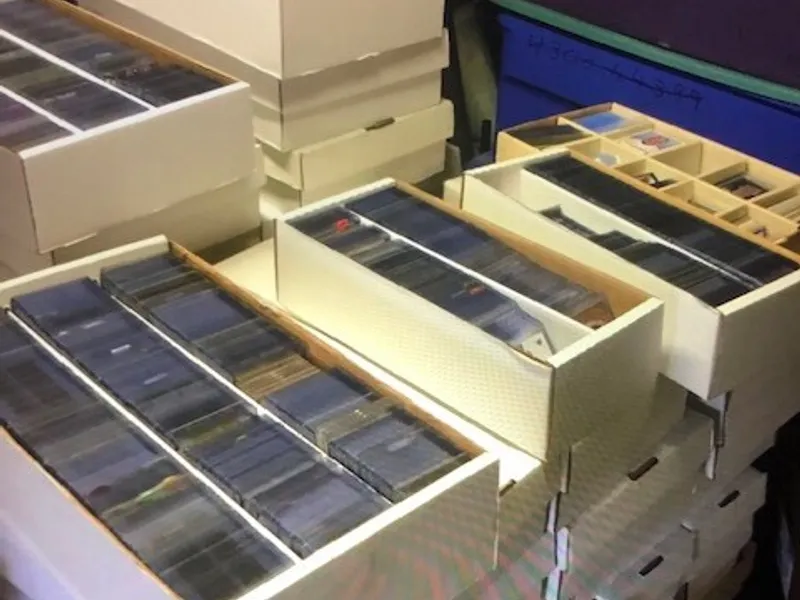
Retail value and a direct cash offer answer different questions. Retail value estimates what cards may produce after they are identified and sold to many end buyers. A cash offer is the amount one buyer can pay now for the collection in its current form.
The gap is not a hidden rule or a fixed dealer percentage. It depends on the card mix, expected selling prices, fees, labor, storage, time, uncertainty, and how much inventory may never sell.
A compact group of popular graded cards can support a different offer relationship than a room of unsorted common cards. The work attached to the collection matters as much as its headline retail estimate.
What Retail Value Assumes
A retail estimate usually assumes the right buyer will find each item and pay a price supported by comparable sales. It often leaves out the steps required to reach that result.
- Identification: each card must be matched to its exact year, set, number, variation, parallel, and grade.
- Condition review: raw cards need honest descriptions and photographs of relevant defects.
- Sales work: items must be listed, marketed, answered, packed, shipped, and tracked.
- Buyer issues: returns, disputes, fraud, and shipping damage remain possible after a sale.
- Leftovers: some cards will sell slowly or will not attract a buyer at the projected price.
What A Direct Buyer Must Account For
We work backward from reasonable expected resale value. We then account for the costs and uncertainty that transfer from the seller to us when we purchase the whole collection.
| Offer Input | Why It Matters |
|---|---|
| Completed-sale evidence | It supports the expected resale value for exact cards, groups, or bulk categories. |
| Marketplace and payment fees | A portion of each sale goes to the platform and payment process. |
| Labor | Sorting, research, listing, customer service, packing, and bookkeeping require paid time. |
| Supplies and shipping | Holders, sleeves, boxes, labels, postage, insurance, and damage claims reduce proceeds. |
| Travel and handling | A collection pickup can require vehicle space, loading time, fuel, and more than one person. |
| Storage and time | Inventory can occupy space and tie up money for months or years. |
| Risk and unsold cards | Condition surprises, falling demand, returns, and items with no buyer reduce the expected result. |
Why One Percentage Does Not Fit Every Collection
A fixed percentage ignores liquidity and workload. One collection may consist of cards with frequent exact sales, while another may contain thousands of cards that require sorting before a marketable lot exists.
Card concentration also matters. A few high-demand cards can carry much of the value and sell efficiently. A similar stated retail total spread across low-value cards may require hundreds of separate transactions.
Compare Net Proceeds Instead Of Gross Prices
If you compare a direct offer with selling cards yourself, compare the offer against expected net proceeds. Subtract selling fees, shipping, supplies, returns, grading costs if any, and the value you place on your time.
Also compare the time to payment and the likely leftovers. A higher gross total can still be a worse fit when it requires months of work and leaves most of the collection behind.
How To Evaluate A Cash Offer
A useful offer explanation should connect the amount to the collection. Ask what the buyer identified as the main value, which sales evidence was used, how bulk was treated, and what work or risk affects the offer.
- Scope: confirm whether the offer includes every card, box, binder, slab, and sealed item discussed.
- Payment: confirm the amount, method, and time of payment before the collection changes hands.
- Inspection: ask what could change after the buyer checks condition and verifies the photographed items.
- Pickup: confirm who handles travel, packing, carrying, and loading for a large collection.
Choose The Tradeoff That Fits The Collection
Selling the strongest cards individually can produce more gross revenue when you have the knowledge, time, and tolerance for risk. A direct sale can fit better when speed, one payment, local pickup, and a clean exit matter more.
Neither number should be presented as the only true value. The useful comparison is expected net money and seller workload under each realistic sales plan.