
Should You Grade Your Cards Before Selling? Costs, Timelines, and When It Makes Sense
Grading can raise what a card brings, but not always. Here is when it pays for itself and when it does not.

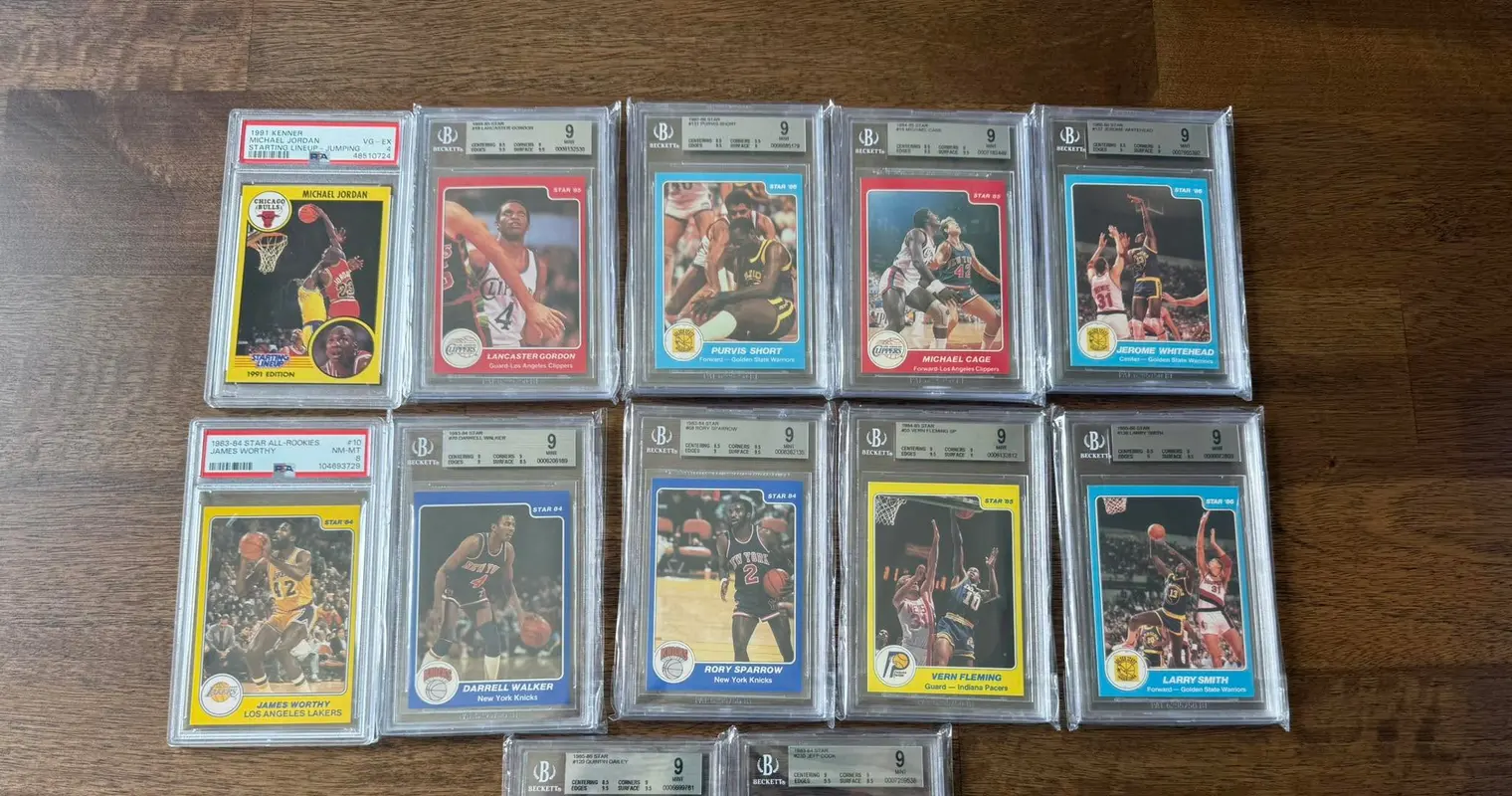
Almost every collection we review has a few cards the owner is considering for grading. A graded card can sell for more than the same card raw, but the added value must exceed the complete cost, delay, and risk of the submission.
This guide covers the cost categories, time commitment, condition checks, and break-even formula. Use it to separate serious grading candidates from cards that are better sold in their current condition.
We buy raw cards every day and we have sold more than 41,000+ cards on eBay since 2005, so we see both sides of this. We are a buyer, not a grading service, which means we have no reason to talk anyone into a submission. For most collections that cross our table, the honest answer is that grading loses to the math.
What Card Grading Actually Costs
Grading costs more than the advertised price for a plastic holder and label. The selected service tier may depend on declared value, card quantity, membership status, and the speed you choose.
Grading companies change service names, fees, value limits, and estimated turnaround times. Check the chosen company's official service page on the day you plan to submit, then calculate every cost below.
| Cost | What To Confirm |
|---|---|
| Grading fee | The current per-card price for the service tier you qualify to use |
| Declared-value rule | The maximum card value allowed at that tier and any possible adjustment |
| Membership or minimum | Any annual membership, card-count minimum, or group-submission requirement |
| Outbound shipping | Postage, insurance, tracking, packaging, and signature service |
| Return shipping | The grader's shipping, handling, and insurance charge |
| Selling costs | Marketplace fees, shipping, supplies, and returns after the graded card sells |
Use current official terms. A fee shown in an old article, video, forum post, or screenshot may no longer apply.
Shipping is easy to miss in the first calculation. Small submissions spread the same packaging and transport costs across fewer cards, so the all-in cost per card can be much higher than the listed grading fee.
How Long Grading Takes
Turnaround is quoted in business days counted from the day the grader logs your submission, not the day you drop it at the post office. Add time on the front for transit and intake, and add more if you submit during a rush, like a major release or the weeks before a big show.
Lower-cost tiers usually trade speed for price, but the posted estimate can change with submission volume. Confirm whether the company measures turnaround from delivery, intake, order entry, or another event.
- Posted estimate: record the current estimated turnaround for the exact tier you will use.
- Outbound transit: include the time required for insured delivery to reach the grading company.
- Intake and processing: check when the company's posted service clock begins and whether delays are possible.
- Return transit: add the trip back and the time required to inspect, list, and sell the graded card.
If you need to sell now, the delay can decide the question before the grade calculation does. A submission ties up both the card and the money spent on it until the card returns and finds a buyer.
The Eight Flaws That Sink Grades
Graders score four things: centering, corners, edges and surface. Nearly every point lost traces back to one of eight specific defects, and most of them are visible with a bright light and a loupe before you spend a dollar on fees.
Check each candidate against this list first. Anything you find here is a reason to expect a lower grade than the card appears to deserve at arm's length.
- Surface damage: scratches, scuffs and gloss loss show up under angled light even when a card looks clean lying flat on a table.
- Centering: uneven borders are the most common reason a fresh-looking card grades an 8 instead of a 10.
- Print defects: ink blotches, registration misses and roller lines come from the factory and cannot be fixed.
- Creases and bends: any fold in the stock caps the grade hard, and a crease running through the image is close to fatal.
- Ink smudging: smearing along an edge or across the name plate turns up often on older and off-brand issues.
- Staining and discoloration: yellowing, foxing and water marks usually trace back to storage in an attic, basement or garage.
- Poor cuts: rough or angled factory cuts, and any sign of trimming, will drop the grade or get the card rejected outright.
- Authenticity problems: reprints and altered cards get flagged, and you still pay the fee for something that comes back unslabbed.
Corners deserve their own pass. Hold the card so light rakes across each corner one at a time, because a corner that reads sharp head-on will often show a soft white point from the side.
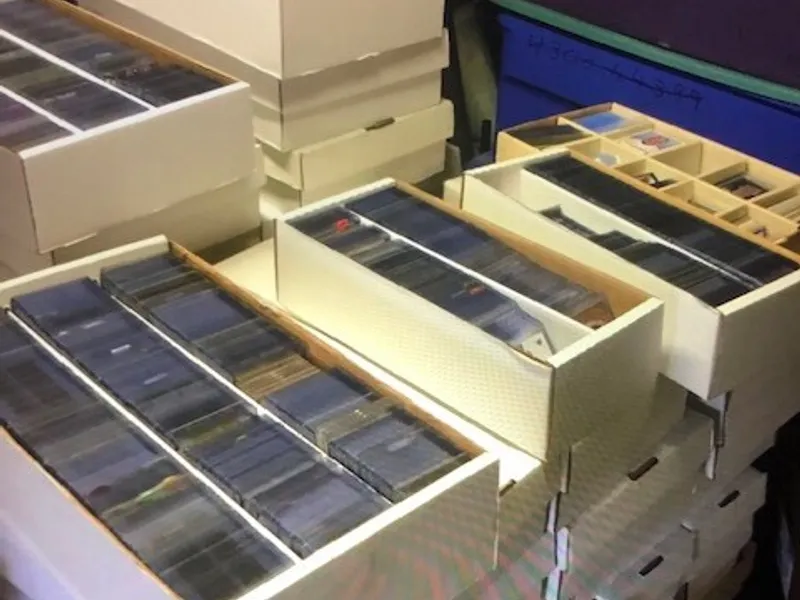
The Break-Even Math
Grading only makes sense when the graded price minus the raw price beats the total cost, after you weight it for the odds of missing the top grade. That last part is where most estimates go wrong, because people price the outcome they are hoping for instead of the spread of outcomes they will actually get.
Use a separate calculation for each card. Start with its realistic raw sale value, estimate several possible grades, assign evidence-based prices to those outcomes, and subtract every submission and selling cost.
A Hypothetical Card Where Grading Loses
Suppose a common modern rookie sells for $20 raw. For illustration, assume a matching grade 9 sale is $45 and a grade 10 sale is $120. The larger top-grade number does not settle the decision because the card may receive a lower grade and every outcome carries costs.
- All-in cost: use the current grading fee plus the card's share of shipping, insurance, supplies, and selling costs.
- Likely outcomes: estimate a realistic range from the actual card's centering, corners, edges, surface, and alteration risk.
- Decision test: compare the expected net result across all likely grades with the $20 raw alternative.
- Against selling raw: $20 today, with no wait, no shipping and no grade risk.
If the likely net result does not beat the raw alternative by enough to justify the delay and risk, grading does not improve the sale. Many low-value cards fail this test even when a top-grade copy has an appealing price.
A Hypothetical Card Where Grading Wins
Now suppose a key card sells for $400 raw, while exact grade-matched sales support much higher prices at grades the card can realistically receive. A wider verified price spread may be enough to absorb the fee and risk.
- All-in cost: use a current service tier that covers the declared value and include every related cost.
- Likely outcomes: use the condition evidence from this specific card, not a generic grading probability.
- Decision test: compare the expected net result across credible grade outcomes with the $400 raw alternative.
- Against selling raw: $400 today.
Grading can make sense when several credible outcomes beat the raw alternative after costs. The decision should not depend on receiving the single highest possible grade.
When Grading Is Worth It
There is a real slice of cards where grading pays, and we say so when we see them. It is narrower than most people expect, and it is defined by value and condition together rather than by the name printed on the front.
These are the cases where we would tell you to submit rather than sell the card raw.
- High raw value: cards with enough raw value and a verified graded-price spread that can cover fees and risk.
- Clean copies: cards already strong on centering, corners, edges and surface, with nothing from the flaw list showing.
- Vintage keys: pre-1980 stars, where authentication by itself changes what buyers will pay.
- Alteration risk: high-value vintage that buyers will discount heavily without third-party verification.
- No rush: you can wait through the company's current processing estimate, shipping, and selling period.
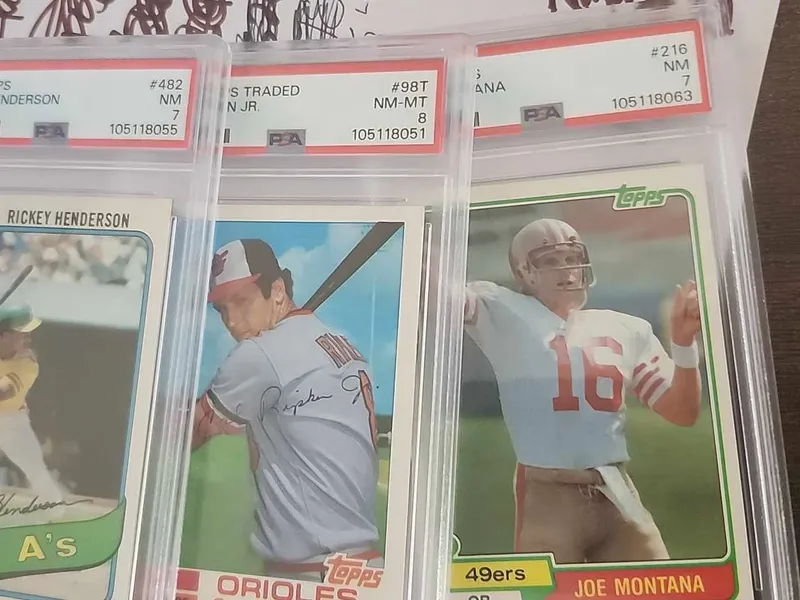
When Grading Is Not Worth It
The rest of the time, grading is a fee you pay to confirm the card is worth roughly what you already thought. We run into this constantly with collections built in the late 1980s and early 1990s, where print runs were enormous and condition does not rescue the value.
Skip the submission when any of the following describes your situation.
- Low raw value: cards where the realistic graded-price spread cannot cover the complete cost and risk.
- Bulk and commons: cards printed in the millions stay inexpensive in any holder.
- Visible flaws: soft corners, off-centering or surface wear that caps the card at an 8 before it ever ships.
- You need the money: the current processing, shipping, and selling period does not fit your deadline.
- Large lots: grading 400 cards to sell one collection turns a simple sale into a part-time job.
There is a quieter cost as well. Every card you send off is a card you cannot sell while it is gone, and collections often bring more as one complete group than as a pile of leftovers plus a few slabs.
What We Do Instead When We Evaluate a Collection
We price raw cards daily, and we price grading candidates as grading candidates. When a card in your collection is genuinely worth submitting, that shows up in what we offer rather than getting buried in a bulk count.
Here is what actually happens when we go through a collection with you.
- We sort first: keys, stars, vintage and any existing graded material get separated from the bulk.
- We check condition: the same eight flaws above, under good light, on anything carrying real value.
- We review condition: centering, corners, edges, and surface help us decide what the card is worth in the collection today.
- We price the whole thing: one number for the collection, in cash, with no sorting or listing work left on you.
Send photos when you want us to evaluate the collection for a possible purchase. We buy both raw and graded cards, but we do not provide grading, authentication, prescreening, submission, personalized grading consultation, or formal documented appraisal services.
The Short Answer
For a small number of cards, grading turns a good card into a much better one and the fee is easy to justify. For most of a typical collection it is a slow, expensive route to roughly the same price you could have taken months earlier.
The test is expected net value, not the best possible multiple. Identify the card, inspect its condition, compare raw and grade-matched completed sales, subtract all costs, and choose the result that still works when the grade is less than perfect.
If you want a buyer to review the collection for a possible purchase, send a few photos or call us at (574) 903-0382. We buy raw and graded cards across Indiana, Michigan and Ohio, and we pay cash when an in-person purchase is completed.